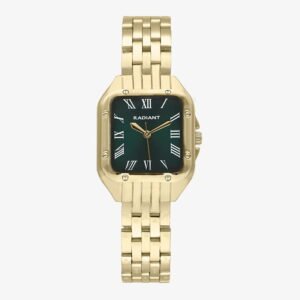

Integrated-bracelet watches were, until recently, a luxury signature. The case and bracelet blend into a single silhouette, which is difficult to execute cheaply without looking unfinished. Tissot solved that problem with the PRX.
The design
The PRX takes its name from “precise” and “robust”, and its shape from a 1978 Tissot model. The case is a flattened tonneau with sharply defined edges, the bracelet tapers continuously into the lugs, and the dial uses a textured surface that catches light rather than reflecting it flatly.
The proportions are restrained. At 40 mm for the automatic and 35 mm for the quartz, both sit comfortably on a wide range of wrists — the 35 mm in particular, which recalls the sizing conventions of the original era.
Why it works where others do not
- The bracelet is genuinely well made. Most affordable integrated designs have a rattly bracelet that gives the game away. The PRX does not.
- Case finishing is honest. Brushed and polished surfaces are clearly delineated rather than smeared together.
- The movement is credible. The automatic uses the Powermatic 80 with an 80-hour reserve — a real technical advantage, not a badge.
- It does not pretend to be something else. The design is coherent rather than derivative.
Which version to choose
| Version | Case | Movement | Best for |
|---|---|---|---|
| PRX Quartz | 35 mm | Quartz | Smaller wrists, low maintenance |
| PRX Automatic | 40 mm | Powermatic 80 | Daily wear, mechanical preference |
| PRX Powermatic 80 35 mm | 35 mm | Powermatic 80 | Smaller wrists wanting automatic |
Living with it
The integrated bracelet limits strap changes — you cannot fit a standard leather strap to the lugs. That is the trade-off of the design and worth knowing before you buy. In return you get a watch that works with a suit and with a t-shirt, which is rarer than it sounds.
Is it worth it?
At its price the PRX competes with watches that offer either a good bracelet or a good movement, rarely both. That combination is why it became a reference point in the segment.
See available Tissot models in our collection.
Frequently asked questions
Is the PRX quartz or automatic better?
Quartz if you want accuracy and minimal maintenance, automatic if you want a mechanical movement and an 80-hour reserve. Both share the same design language.
Can I change the bracelet on a PRX?
Only to Tissot’s own PRX straps. Standard straps cannot be fitted because of the integrated lug design.
Does the PRX wear large?
The 40 mm automatic wears close to its nominal size thanks to short lugs. The 35 mm suits smaller wrists particularly well.